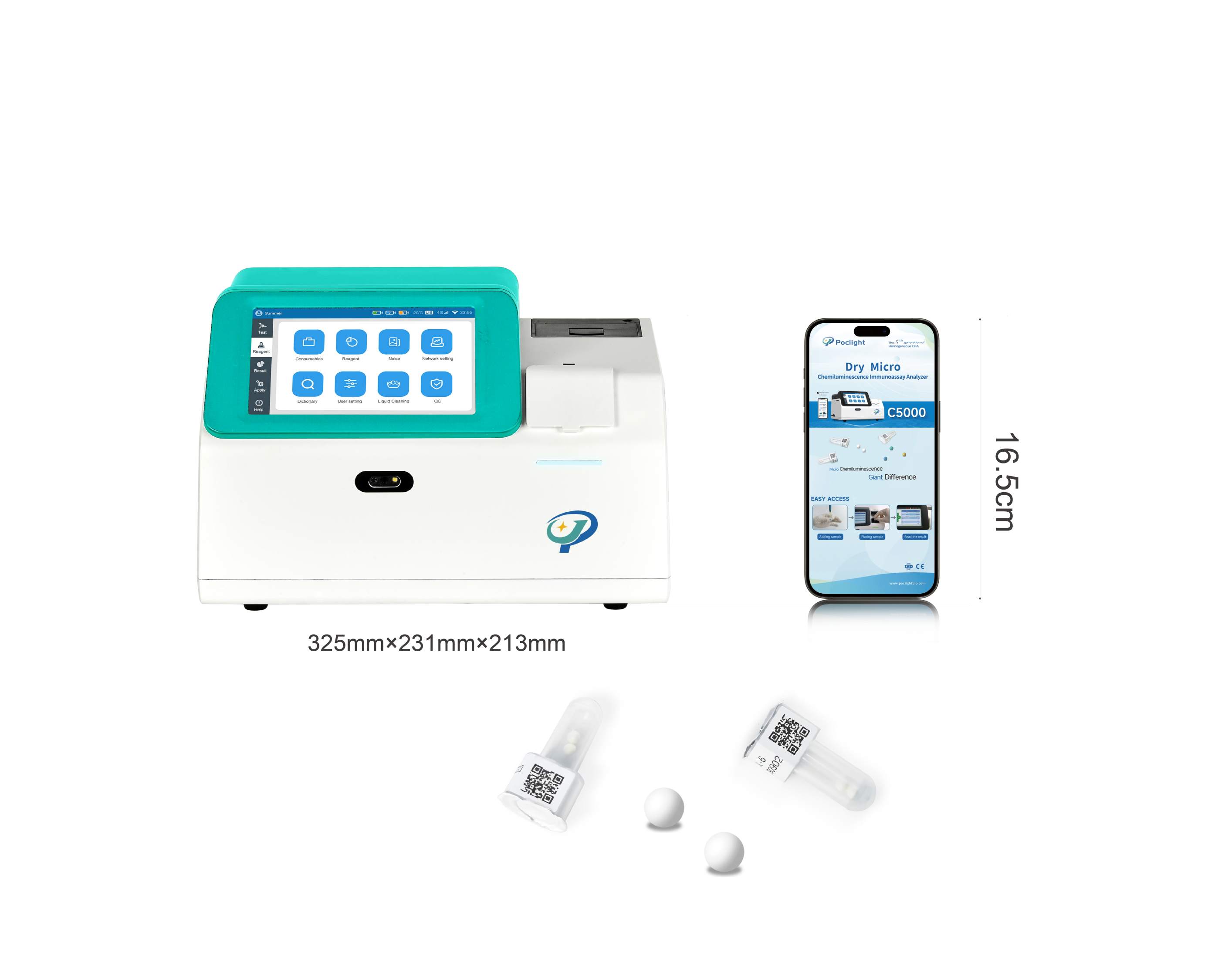
The Poclight C5000 is our compact, semi-automated homogeneous chemiluminescence immunoassay (CLIA) analyzer, developed to support quantitative biomarker testing in professional healthcare settings. Powered by our chemiluminescence resonance energy transfer (CRET) technology, the system combines a wash-free analytical workflow with individually packaged lyophilized reagents.
The C5000 reagent portfolio covers a range of clinical needs, including inflammation, cardiac assessment, thyroid function, reproductive health, tumor markers, and metabolic testing. This guide introduces representative assays, explains how different immunoassay designs relate to the platform, and outlines the factors laboratories should consider when selecting a test menu.
The assays described here are examples from our product portfolio, not a guarantee that every assay is commercially available or authorized in every country. The applicable reagent instructions for use (IFU) and local regulatory status take precedence.
Key Takeaways
What Is the Poclight C5000?
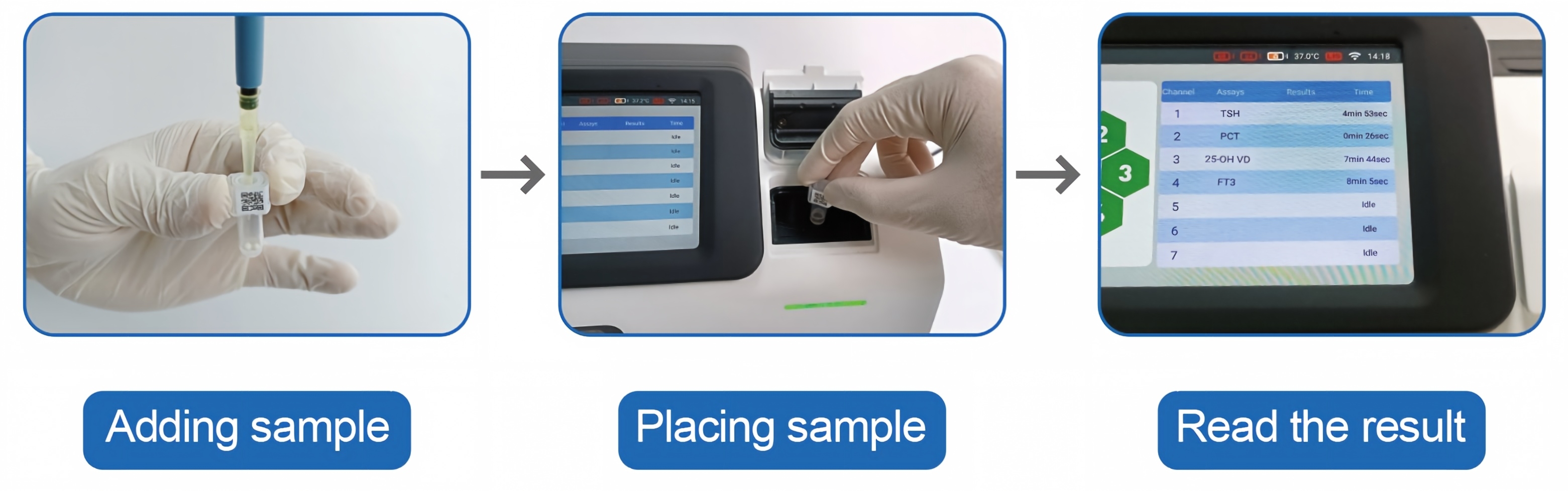
Our C5000 is designed for laboratories and healthcare facilities seeking to perform selected quantitative immunoassays on a compact benchtop system. It has seven independent detection channels that support parallel testing and flexible test scheduling. The instrument is semi-automated: trained operators remain responsible for specimen handling, reagent preparation where required, loading, quality control, and result review.
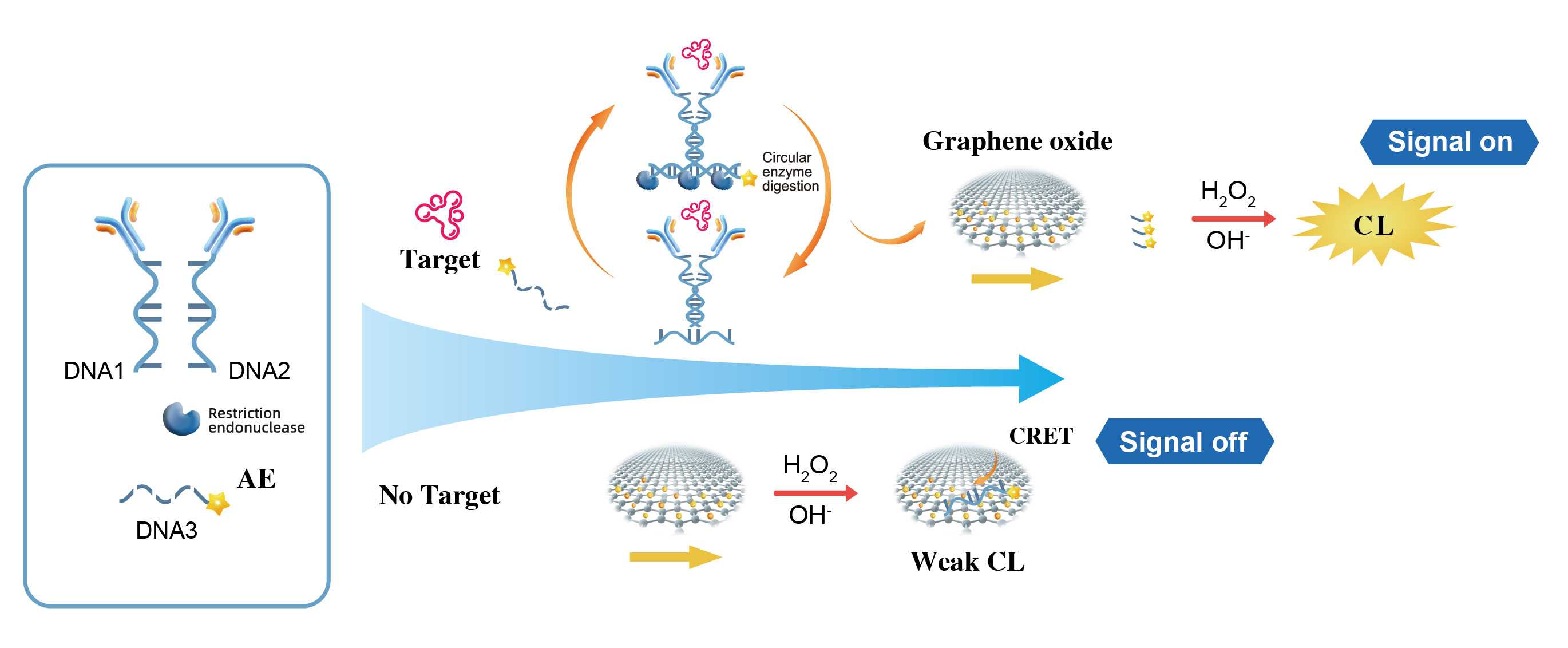
At the heart of the system is CRET-based homogeneous detection. In our described technology, an acridinium ester chemiluminescent label and graphene oxide quenching are used to differentiate analyte-dependent signals within the reaction mixture. Unlike conventional heterogeneous CLIA workflows, this approach does not require the physical bound/free separation and washing sequence used in many magnetic-particle systems.
Individual-test lyophilized reagents also support on-demand operation and help simplify reagent management. Storage and transport conditions must follow the label for each reagent; room-temperature handling is applicable only when specified and validated for that product. The time required to obtain an analytical result depends on the assay and should not be confused with the complete sample-to-report turnaround time.
Which Immunoassay Formats Are Relevant to the C5000?
The terms sandwich and competitive describe how an assay recognizes its target. Homogeneous CLIA describes the detection workflow. These concepts are related but should not be used interchangeably.
A sandwich, or two-site, assay typically uses two binding reagents that recognize different accessible sites on the same analyte. It is commonly applied to proteins and other targets that permit simultaneous recognition. Our published insulin and placental growth factor (PlGF) assay descriptions provide examples of dual-site designs using homogeneous CRET technology.
In a competitive design, analyte in the sample competes with a reagent component for a limited binding interaction. This approach is often useful for small molecules that may not be suitable for a conventional two-site sandwich configuration. However, an analyte's size or clinical category alone does not establish how a particular C5000 reagent works.
Immunometric is a broad term that can include noncompetitive formats, including sandwich assays; it is not always a separate, mutually exclusive third category. Reagent documentation may use more specific classifications. For technical and regulatory accuracy, the reaction format and signal–concentration relationship of each C5000 assay should be confirmed from its own IFU rather than assumed from a general platform description.
Regardless of assay format, sensitivity, precision, interference, and other analytical characteristics require reagent-specific evaluation. The use of CRET technology alone does not establish the clinical performance of every assay.
C5000 Test Menu by Clinical Area
Our reagent portfolio includes assays relevant to the following clinical areas. The table is a practical overview of representative biomarkers and potential clinical contexts; it is not a fixed multi-analyte panel or a statement of regulatory approval.
|
Clinical area |
Representative C5000 assays |
Potential clinical context |
|
Inflammation |
CRP, SAA, PCT, IL-6, KL-6, HBP |
Supporting clinician-directed assessment of inflammatory processes and selected conditions |
|
Cardiac markers |
hs-cTnT, BNP, NT-proBNP, CK-MB, myoglobin (Myo) |
Supporting evaluation of myocardial injury and selected cardiovascular presentations |
|
Coagulation-related assessment |
D-dimer |
Supporting assessment in appropriate, validated diagnostic pathways |
|
Thyroid function |
TSH, FT3, FT4, TT3, TT4 |
Assessing thyroid function and related endocrine disorders |
|
Reproductive hormones and fertility |
β-hCG, AMH, FSH, LH, estradiol (E2), progesterone, prolactin, testosterone, cortisol |
Supporting reproductive, pregnancy-related, and endocrine assessment |
|
Tumor markers |
tPSA, fPSA, CEA, AFP, CYFRA21-1, CA19-9, CA125 |
Supporting selected oncology-related assessment or monitoring where indicated |
|
Glucose metabolism |
HbA1c, insulin |
Supporting metabolic assessment and diabetes-related care where indicated |
|
Nutrition, bone metabolism, and anemia |
25-OH vitamin D, ferritin, Active B12 (AB12) |
Supporting assessment of vitamin D, iron status, and biologically available vitamin B12 |
|
Allergy-related assessment |
IgE |
Supporting allergy-related evaluation according to the reagent's intended use |
|
Maternal health |
sFlt-1, PlGF |
Supporting specialist assessment of placental biomarkers where clinically indicated |
These biomarkers are not interchangeable with one another, and their presence in a product portfolio does not mean they are ordered, measured, or interpreted as a single combined panel. Requests for a complete market-specific assay list should be checked with our team.
Understanding the Clinical Applications
The inflammation portfolio includes markers used in different clinical circumstances. For example, CRP, SAA, PCT, and IL-6 may contribute information about inflammatory or infection-related processes, while KL-6 and HBP address more specialized clinical questions. The appropriate use of each marker depends on the validated intended use and the broader clinical picture.
Our cardiac-related menu includes hs-cTnT, BNP, NT-proBNP, CK-MB, and myoglobin. These assays address different aspects of cardiac assessment. Cardiac troponin interpretation, in particular, depends on the assay's validated performance, serial results when indicated, the patient's symptoms, electrocardiographic findings, and clinical guidance. Neither a single troponin result nor a product-level claim about analytical speed should be presented as a stand-alone rule-out or diagnosis of acute myocardial infarction.
D-dimer may support appropriate thrombosis-related diagnostic pathways, but its interpretation is dependent on the patient population, clinical probability, and applicable clinical protocols.
The C5000 menu includes thyroid-related assays such as TSH, FT3, FT4, TT3, and TT4. These markers support assessment of thyroid status when interpreted together with the patient's history and other findings.
For reproductive and endocrine testing, our portfolio includes AMH, FSH, LH, estradiol, progesterone, prolactin, testosterone, β-hCG, and cortisol. Laboratories can select relevant assays for their service profile rather than assuming every hormone must be included in a routine panel. Assay formats, sample requirements, and interpretation are reagent-specific.
Our tumor marker portfolio includes PSA-related assays and markers such as CEA, AFP, CYFRA21-1, CA19-9, and CA125. Their clinical roles differ substantially. Tumor markers should be ordered and interpreted within the relevant clinical context and should not be described as universally suitable for population screening or as definitive diagnostic tests on their own.
The metabolic portfolio includes HbA1c and insulin. HbA1c interpretation must consider the assay's validated method and any patient-related factors that may affect results. Claims about traceability, certification, or equivalence to another laboratory method require current documentation for the specific test system.
The menu also includes 25-OH vitamin D, ferritin, Active B12, IgE, sFlt-1, and PlGF. Active B12 is distinct from a total vitamin B12 assay and should not be labeled as Total B12. Similarly, an IgE assay should not be represented as an allergen-specific test unless that function is expressly included in its IFU.
For maternal health, sFlt-1 and PlGF may provide information relevant to specialist assessment of placental function and preeclampsia-related risk. Any use of an sFlt-1/PlGF ratio or associated clinical decision threshold must be supported by the specific assays' validated intended use and relevant local guidance.
How to Select a C5000 Assay Menu for Your Laboratory
When considering the C5000, we recommend assessing the following factors before selecting reagents:
· Clinical demand: Identify the biomarkers routinely requested by your institution and the clinical pathways in which they will be used.
· Local availability: Confirm which assays and instrument configurations are available and authorized in your country.
· Validated specimen types: Check each IFU for accepted specimen types. Although the C5000 platform supports whole blood, serum, and plasma in applicable workflows, whole-blood compatibility must not be assumed for every reagent.
· Analytical evidence: Review assay-specific performance information, including precision, interference, calibration, and quality-control requirements, against your laboratory's needs.
· Operational fit: Consider staffing, testing volume, reagent storage, instrument maintenance, biosafety procedures, and integration into existing workflows.
Our team can help laboratories and IVD distributors review the available menu and identify a configuration aligned with their intended application. Product selection should be based on both clinical requirements and the approved documentation for the destination market.
Frequently Asked Questions
Yes. The C5000 has independent detection channels and supports assays from different clinical areas within the compatible reagent portfolio. Individual assays are performed according to their respective instructions; a group of listed biomarkers is not automatically a single multiplex test.
No. Our CRET-based homogeneous CLIA approach does not use the conventional magnetic-bead bound/free separation and washing sequence. Standard sample handling, instrument care, quality control, and laboratory waste procedures are still required.
These specimen types are supported across the platform where validated, but accepted specimens differ between assays. Always refer to the applicable reagent IFU for the permitted sample matrix and handling requirements.
Active B12 (AB12) is listed in our reagent portfolio. It is different from Total B12. Please confirm the relevant reagent's commercial availability and registration status for your market.
No. Commercial availability, regulatory status, intended use, and reagent documentation may vary by country and product version. We can provide market-specific information on request.
Explore the C5000 Test Menu With Poclight
At Poclight, our goal is to make professional chemiluminescence immunoassay testing easier to deploy through compact instrumentation, a simplified wash-free workflow, and individually packaged lyophilized reagents.
If you are planning a laboratory menu or evaluating distribution opportunities, contact our team with your country, organization type, and assays of interest. We can discuss the locally available C5000 reagent portfolio, instrument configuration, and the documentation relevant to your market.
Contact: overseas@poclight.com
For professional in vitro diagnostic use. The intended use, specimen requirements, performance characteristics, storage conditions, and regulatory status of each assay are governed by its applicable labeling and instructions for use. Biomarker results must be interpreted by qualified healthcare professionals in the appropriate clinical context.



 Specated Ipv6 Network | XML | Sitemap | Блог | политика конфиденциальности
Оставить сообщение
Сканировать в WeChat :


 English
 français
 русский
 español
 português
 العربية
 日本語
 Türkçe
 हिंदी
 Indonesia